
Was für ein Corpus!
Réquichot at Michael Werner’s in Berlin
Franfurter Allgemeine Zeitung, 28 février 2026
Michael Werner has already attempted to introduce the work of the French artist Bernard Réquichot to the German market: in 1970, at his Cologne gallery, in a joint exhibition with the Surrealist Christian d’Orgeix. The names of the two artists did not really gain traction, even among a specialized and informed public. How surprising this should be in Réquichot’s case is now demonstrated by a preview at Werner’s Berlin gallery, featuring approximately forty drawings, collages, and a few rare sculptures by the writer and collage artist born in 1929 in Asnières-sur-Vègre. All his works are distinguished by an unusual intensity. Although the exhibition is modest in size, the quality of its pieces fully meets the requirements of a museum.
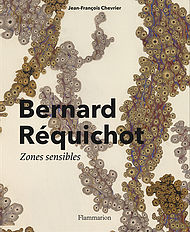
A reel carnage unfolds on paper, cardboard, andwooden panels. Strangely, fragments of bodies, open mouths, and shreds of raw flesh ntertwine; with a singular pleasure in destruction and deformation, the artist lets configurations of entrails float and dance against a light background; teeth of all kinds clash together. One of the qualities of this work lies in the fact that Réquichot copies these pictorial particles, uses them in series, and thus intensifies their effect.
Some stretched and liquefied forms, among the hairstyles, eviscerated bodies, carrots, and rows of teeth, appear, from today’s perspective, to have been manipulated with software like Photoshop. In two boxes reminiscent of reliquaries, heaps of paint, as thick as a finger, are grouped together, incorporating bones – thankfully now unrecognizable. A tendency toward abjection is, however, undeniably present.
All these works from the late 1950s, seemingly light, are in reality quite austere. They demonstrate the potential for developing Kurt Schwitter’s collage technique. In delicate pen drawings, spirals undulate within undefined spheres, fantastical webs spread across the heart of the pictorial space, as if observed under a microscope – evoking the style of Wols.
Réquichot did not live long enough to see the 1964 Documenta exhibition; at a very young age, he committed suicide in 1961 by jumping from the fifth floor. Yet, it is not this tragedy that lends his work an apparent strangeness. Its strength lies in a sensitive and infallible mastery, upon which the artist could rely. The drawings bear no trace of corrections. Approximately half of the works on display come from the collection of Michael Werner, who assembled them over the decades and can now present them. The other half comes from the collections of the Parisian gallery Alain Margaron (prices range from €25,000 to €600,000).
GEORG IMDAHL
Réquichot, Galerie Michael Werner, Berlin
Jusqu’au 11 avril,
Catalogue, 40 €